Growing careers when I can't promote
I think growth and mentorship are foundational to team culture. And when I can't promote, I find other ways to reward performance.
Step 1: Discover Ambitions
As part of my leadership style, I ask a lot of questions about a person's career aspirations and their ambition. It also helps me understand each individual's expectation of the future.
The middle cohort is the toughest. They want me to give them answers. They get frustrated when I tell them that a career in this field isn't a straight line. I suggest a framework for researching and learning about going deep into a specialization or staying a generalist.

Sample questions about ambition
Do you want to be a manager? A senior-level individual contributor?
What's an area that interests you that you aren't doing?
What skills do you have that are untapped?
Step 2: Clarity of the Current Role
I think beyond the job description. Job descriptions are too general to be helpful for daily expectations. At both AIG and Shutterstock, I started from zero. There was no clarity on daily needs for a designer and no parity across the group. We had big gaps.
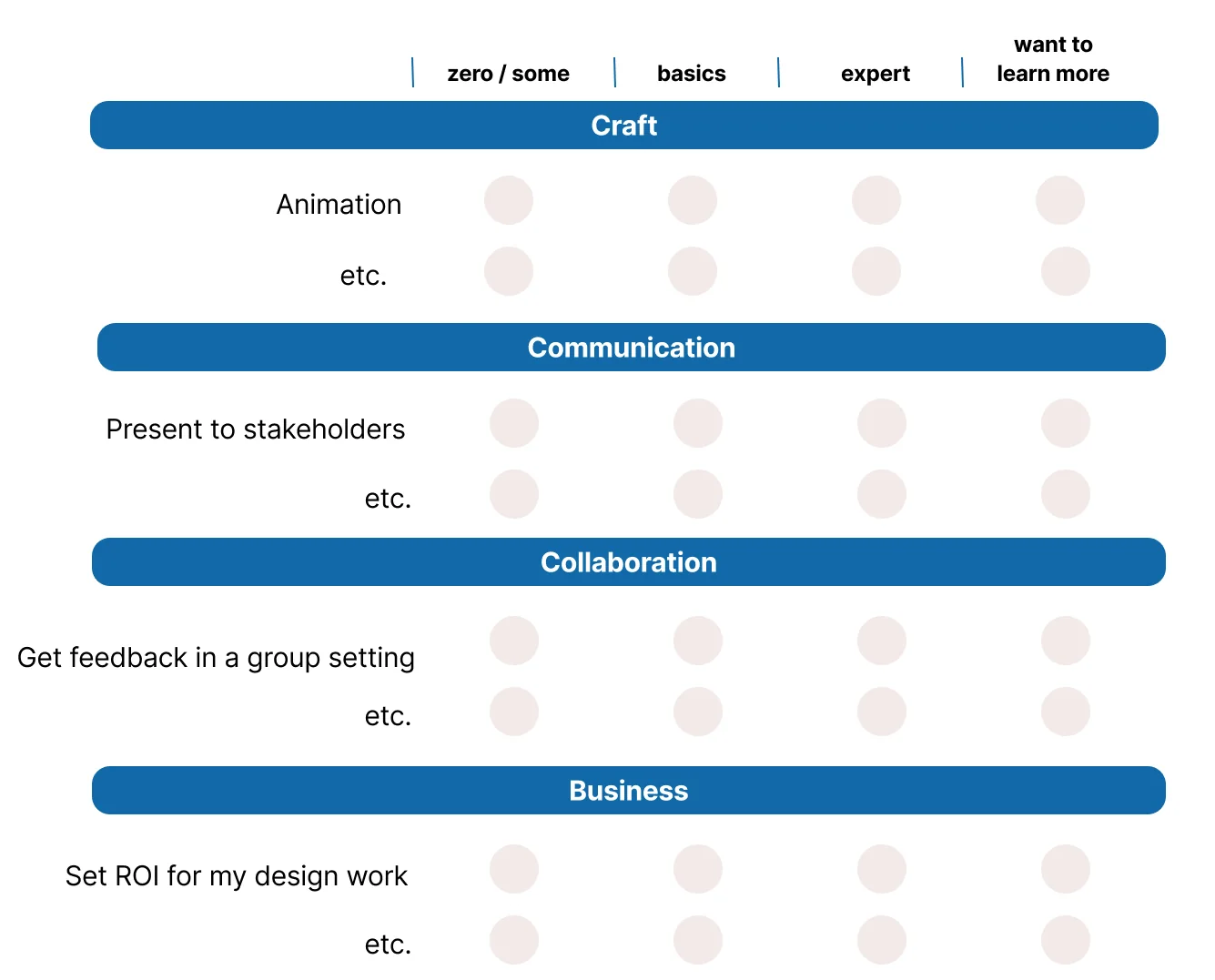
With both teams, I built a framework based on four categories and added a collection of sub-skills. It gave the team a chance to learn my expectations and what I value from teams. I use these foundations for self-assessments and building growth plans.

Craft
T-shaped skills that include everything from user research, facilitation, process diagrams, wires/comps/code, animation, etc.

Communication
Text, diagrams, presentations—the ability to articulately convey one's thoughts. It's old but good: if you can't communicate your idea, it doesn't exist.

Collaboration
The ability to negotiate, give and receive feedback, and maintain relationships.

Business
Understand how the company makes money, the difference between growth and cost, and how to measure design.
Self-assessment
I was transparent about my goal: a shared understanding so we can work together on growth and annual reviews.
This diagram generated great conversations—some of them difficult. Thinking beyond craft was difficult, and often involved activities people didn't like.
The diagram's subcategories changed based on the company. At Shutterstock, I focused on collaboration. The team had a terrible reputation and we needed to repair it.
 © 2026 Jody Hankinson
Step 3: Growth Plan
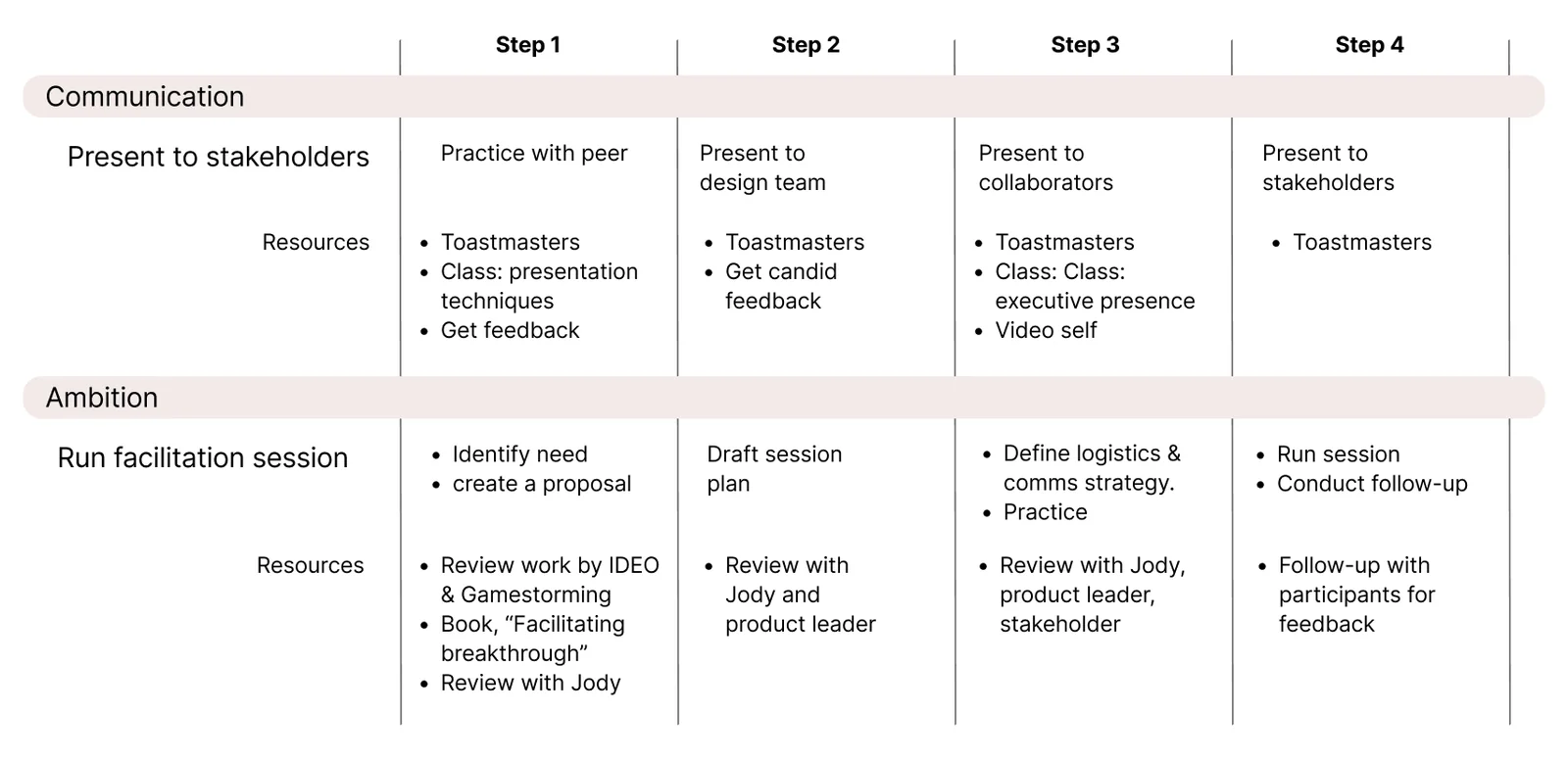
My favorite part of the process is the growth plan. I provided the framework and the most curious would come to me with a draft. For others, the process started as a conversation with me.
For annual goals, these growth areas are in addition to the project work. However, the goal is to integrate career growth into the project work. I did not want it to be a separate track.
In the diagram, phases are gates to set expectations and to show when the person needs to pivot.
 © 2026 Jody Hankinson